Artwork by Grace Ndiritu transforms our renovated theatre
GRACE NDIRITU

'The Last Days of Ancient Sunlight' is a sensory and spiritual invitation from the London artist Grace Ndiritu to heal our relationship with the natural world. The artist transforms the theater not only physically but also energetically. The building becomes a place for reflection, healing, and action. This total work of art has been realized within the percentage scheme during the renovation and serves as an artistic reflection on a world in crisis.
- Interview Hilde Van Canneyt -
Dear Grace, can you tell me something about your project for Schouwburg Kortrijk?
“'The Last Days of Ancient Sunlight' is not only an artwork but also a ritual invitation: a call to awaken and heal ourselves and the theater as a collective space. It is a total installation that grows like a new skin around and within the Schouwburg. It will be a place that breathes. The title refers to Thom Hartmann's book The Last Hours of Ancient Sunlight and echoes his central idea that we are living in a transitional time that forces us to learn again how to relate to the earth, energy, and community. The project transforms the Schouwburg into a symbolic and sensory space where nature returns. This happens not only through the plants in the spaces but also through images, light compositions, and architectural interventions. The theater becomes a refuge where the rising sun (think: 'inner sun'), as well as the pink hour, announces change. The large windows and glass doors at the front bring outside light and the greenery of the city inside through transparent, watercolor-colored windows in yellow, pink, and orange, the colors of transformation.”
How does your project for the Schouwburg connect with your previous work?
“This project builds on my long-standing practice around ecology, spirituality, and the healing of institutional spaces. In previous projects like 'Healing the Museum' and 'The Ark', I explored how museums and theaters are not only physical buildings but also energetic structures where historical traumas, visions of the future, and social relationships gather. 'The Last Days of Ancient Sunlight' fits perfectly into that trajectory: it is both a redesign of the Schouwburg and a spiritual-ecological gesture. I am working again from a holistic approach where architecture, programming, and education mutually reinforce each other. The neon letters in yellow, pink, or gold above the bar and the theater hall, the watercolor windows, and the plant-inspired interventions are not ornaments but signs of a larger process: the healing of the building and its visitors. With these interventions, I want to create a space where art is not only observed but becomes a transformative experience.”
How has your research, particularly the exploration of Kortrijk's museum collections and archives, stimulated the project?
“Together with the influence of Henri Rousseau's paradisiacal forest fantasies and the unique historical sets of Albert Dubosq, Savery's work forms one of the main sources of inspiration for the visual vocabulary of this project. During my research in Kortrijk, I discovered parallels between the contemporary ecological emergency and early modern representations of nature. The 17th-century painting 'The Watering Place' by Roelant Savery played a key role in this. Savery depicts a woodland landscape where architectural elements are overgrown by lush vegetation. It is an image that is both romantic and prophetic. It reminds us of the transience of human civilizations and the inevitable return of nature. The image of nature reclaiming human structures is literally and figuratively reflected in the project: the elements on the renewed facade seem to overgrow the building. The city theater is thus reconnected with the medieval forest that once stood in this place. The building becomes, as it were, an organism, not a stagnant stone 'monument'.
What role does architecture play in your project? And how does this relate to the historically unique theater sets, such as Forêt Asiatique from 1921 by scenographer Albert Dubosq, designed for the opera Lakmé?
“The link with historical sets is very important. Dubosq created an idyllic, tropical set full of trees, vines, and blooming plants in various shades of green to pink-red. I did not want to reproduce his exoticism but rather his ability to create an overwhelming landscape within a theater. The architectural style of the Stadsschouwburg literally carries the project. I see it as a membrane between inside and outside, past and future. Through my interventions, that membrane becomes porous, and the building will breathe. In 'The Last Days of Ancient Sunlight', the theater becomes a forest again, but this time a forest based on ecological reality and historical restoration processes. The architecture serves as a place where nature can manifest conceptually and physically, creating a magical space that hopefully brings the visitor into a state of slowing down and wonder.”
Why was it important to collaborate with the team from a holistic approach to the Schouwburg and thus (together) produce new artworks and interiors?
“Because the project is about transformation: personal, ecological, and institutional." It was crucial that the artwork would not just become an object or decorative piece but a complete ecosystem. That is why I worked intensively with the team, so the artwork would not exist alongside the Schouwburg but grow through it. Everything is part of the same philosophy: art must shape the infrastructure and daily rhythm of the cultural house. Through this holistic approach, the theater becomes not just a conduit for performances but a space of continuous renewal, where the audience keeps returning. The goal is nothing less than healing the relationship between humans, buildings, and nature.”
Can you briefly explain the educational programs within 'The Last Days of Ancient Sunlight'?
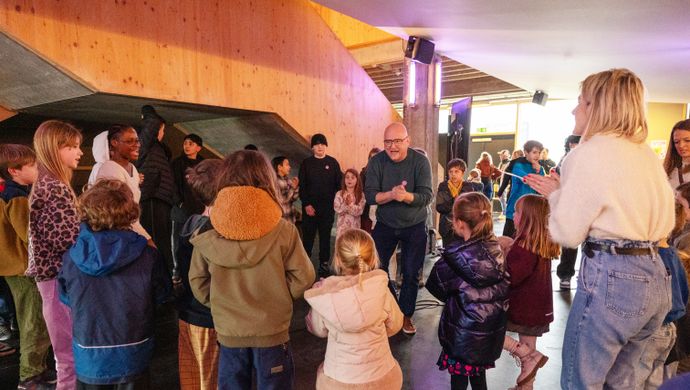
“'The Children's Climate Choir' is a long-term project where young people meet weekly to sing old and new protest songs focused on ecology, care, and future thinking. By occasionally performing (for) an audience, they bring the strategy of enlivening the building to life: the building is filled with their voices and energy, causing the theater to literally resonate. In this way, the choir builds a sustainable relationship between children and the theater, allowing new generations to feel at home in this 'healing' space.
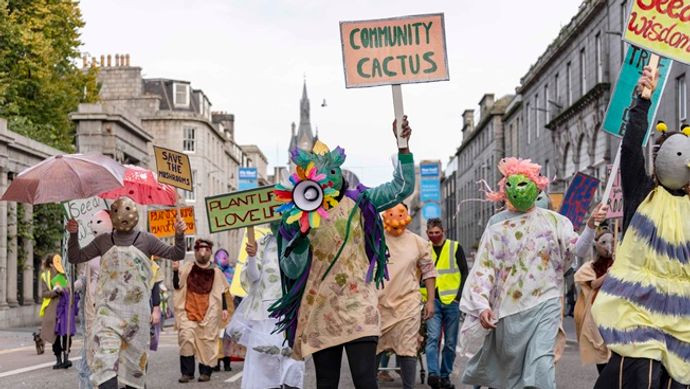
The participatory component of 'Plant Theatre For Plant People' brings people together to create costumes, protest signs, and ritual objects while collectively performing ecological and spiritual exercises. This Plant Theater aims to be playful, activist, and connective. It brings the theater to the street and the street to the theater, emphasizing ecological awareness and social change.
Under the banner of 'Forest Laureate Lecture', the Schouwburg invites an inspiring thinker such as a writer, philosopher, or activist to open the year with a message of hope and action. This lecture builds on the historical tradition of the theater as a place of debate and imagination but shifts the focus to ecology and mental transformation.”
Cocreative workshops Grace Ndiritu