


1 General Framework
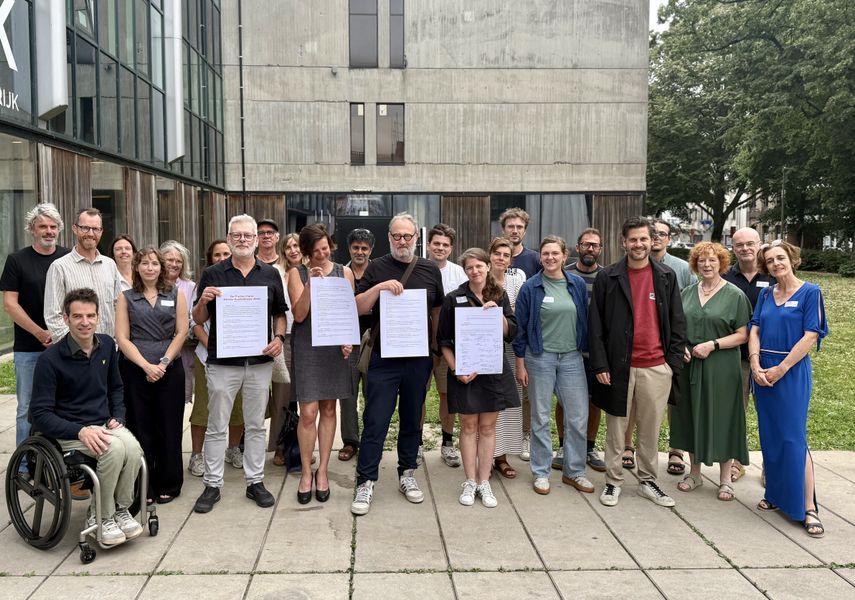
This Fair Practice Charter is about clear and fair principles and practices for collaborations in the broad cultural sector. For all subsectors and disciplines. And for all parties involved.
With ‘KKO’ (Kortrijks KunstenOverleg), the actual association/organization/network of members/advisory body for the City of Kortrijk and all individual members/organizations that are part of it is meant.
The goal of this Fair Practice Charter is to establish internal agreements and use them as a standard. We endorse this charter as a guideline in negotiations and agreements with externals with whom we have a relationship as a client: artists, cultural workers, youth workers, educators, freelance employees, volunteers, and others. We also promote these principles and agreements of Fair Practice to organizations and partners outside the KKO.
We align ourselves with the principles and agreements as formulated on www.juistisjuist.be.
2 Principles of fair practice
We endorse the 4 principles of Just is Just and apply them in relationships with individuals or organizations with whom we have a relationship as a client:
2.1 Solidarity
We have a collective social responsibility when it comes to the appreciation of work and quality collaborations. We are aware of the potential impact of our actions on the position of others. We strive for fair compensation/appreciation and a safe working environment for everyone.
2.2 Transparency
We ensure that we know what we are talking about and strive for equality among all conversation partners. We are transparent with each other throughout the entire process and every collaboration regarding our expectations and the appreciation of everyone's contributions.
2.3 Sustainability
We support each other in building sustainable collaborations and in knowledge and experience development. This can only happen within the applicable frameworks and under fair conditions.
2.4 Responsibility
Sustainable collaborations arise from shared responsibility and mutual trust. It is therefore important that both parties get to know each other and appreciate each other's efforts, risks, and commitment at all levels.
3 Agreements of fair practice
We endorse the 12 agreements of Juist is Juist and apply them within our organizations:
3.1 Dialogue
We ensure discussion moments with other organizations or individuals (employees, freelancers, volunteers, etc.) during the preparation, execution, and evaluation of work processes and activities. Compensation and collaboration conditions are a fixed topic of discussion.
We commit to making clear agreements in advance with organizations and employees about how compensation will occur, so that this is clear for both sides and contracts can be prepared in a timely manner.
3.2 Responsibility
We clarify who has which responsibility for each performance that occurs on our behalf or in collaboration with our organization(s), both in terms of content and practically.
3.3 Payment (Fair Pay)
We start from an open dialogue regarding Fair Pay in every professional context.
We pay in all agreements where we act as a client according to the sector-specific collective labor agreement.
We stipulate in collaboration contracts with other organizations that act as employer/client/main producer that they are expected to compensate their employees correctly and to meet all legal obligations and expenses related to employment and insurance.
We also engage in discussions if assignments (e.g., performances, presentations, concerts, lectures, workshops, etc.) are canceled due to force majeure. The starting point is to safeguard the allocated resources and explore the possibilities for postponing the assignment. Depending on the situation of the other party, we decide in consultation who reimburses which incurred costs and/or whether a cancellation fee (30% as a guideline) will be applied.
We compensate freelancers with a fee calculated based on at least the wage cost of an employee in a similar position.
3.4 Time investment
We make the time investment of a contractor the subject of a transparent discussion, where 'time' of a contractor is an important factor in making an agreement, alongside the intended result and/or the work process.
3.5 Engagement
Once the commitment to collaborate is made, we put that commitment in writing. We make agreements about the compensation or appreciation of all performances, including preparation and settlement.
3.6 Employment form
We work together with the contractor to find the most appropriate form of employment or engagement. We inform about all possibilities. During discussions of collaboration with precarious groups such as newcomers, long-term unemployed, and people with physical and mental disabilities, we take their status into account.
3.7 No improper use
The provisions in the agreements we draw up correspond to the actual situation. We avoid improper use, e.g., artificially shortening or extending contracts. We inform our contractors about the consequences of this.
3.8 Temporary work
We follow the regulations regarding temporary work and report gross wages to temporary employment agencies and third-party payers instead of total invoice amounts or budgets.
3.9 Intellectual property rights
We respect intellectual property rights to the fullest extent.
When transferring or granting intellectual property rights, we make clear agreements about the compensation, scope, and duration. Due to the principle of reasonableness, we commit not to transfer more rights than necessary for the intended purpose.
We take fair professional practices into account when determining the ratio between the compensation for the performance on one hand and the compensation for the transfer or granting of rights on the other hand.
3.10 Amateur arts compensation
We only apply the Amateur Arts Compensation (AKV) for occasional, small-scale artistic performances (cf. workinginthearts.be).
3.11 Internships
Every internship is framed within a learning context and is meaningful for the intern, the educational institution, and the internship provider.
3.12 Volunteer work
We commit to outlining a clear volunteer policy within our organization and only enter into volunteer agreements for work of a voluntary nature.
4 Inclusivity
We strive for an inclusive work environment for employees, freelancers, volunteers, and other staff, and we are aware of our shortcomings, both organizationally and infrastructurally.
We are committed to being a flexible environment and adapting our vision, tools, and opportunities to the pace, capabilities, and needs of our employees, contractors, volunteers….
5 Discrimination & inappropriate behavior
We identify with the principles of Engagementarts.be and want to be a safe place for all employees, participants, volunteers, and the public. We welcome diverse voices, backgrounds, and perspectives.
We oppose any form of discrimination based on gender, sex, origin, nationality, age, (religious) belief, disability, sexual orientation, or other factors and actively work to eliminate these in our organization(s).
We oppose any form of inappropriate and aggressive behavior.
We focus on prevention and provide sufficient space to engage with employees about inappropriate behavior and to keep the conversation open. We include a clause regarding inappropriate behavior in contracts with employees and contractors.
6 Reciprocity
Fair Practice starts from the notion of ‘reciprocity’. We are aware of the power position we often automatically occupy and provide the necessary attention to give a voice to the people or organizations we work with on an equal footing.
We ask our employees and contractors, regardless of the role they take within our organization(s), to:
● resist pressure to act inappropriately;
● speak out, even on difficult topics, even if opinions differ;
● consult others when in doubt. It is not expected that everyone knows everything or solves everything alone;
● participate in training and education and ensure that the vision of our organization(s) regarding inclusion, discrimination, and inappropriate behavior is represented in their work.
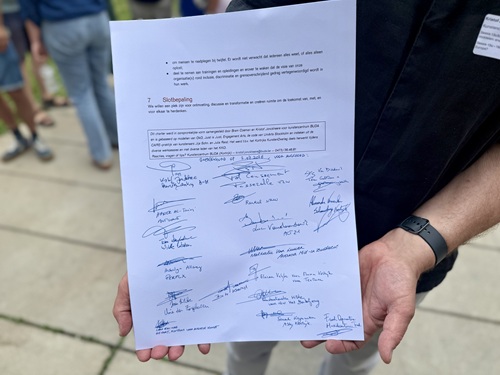
7 Slot Determination
We want to be a place for meeting, discussion, and transformation, and create space to rethink the future of, with, and for each other.
| This charter was originally compiled by Bram Coeman and Kristof Jonckheere for the arts center BUDA and is based on models from OkO, Juist is Juist, Engagement Arts, the code of UniArts Stockholm, and insights from the CARE practice of artists Jija Sohn and Julia Reist. It was partially revised for the Kortrijk Arts Consultation during various working sessions with several members of the KKO. |
Comments, questions, or tips? Arts center BUDA (Kortrijk) – kristof.jonckheere@buda.be – 0473/36.46.81